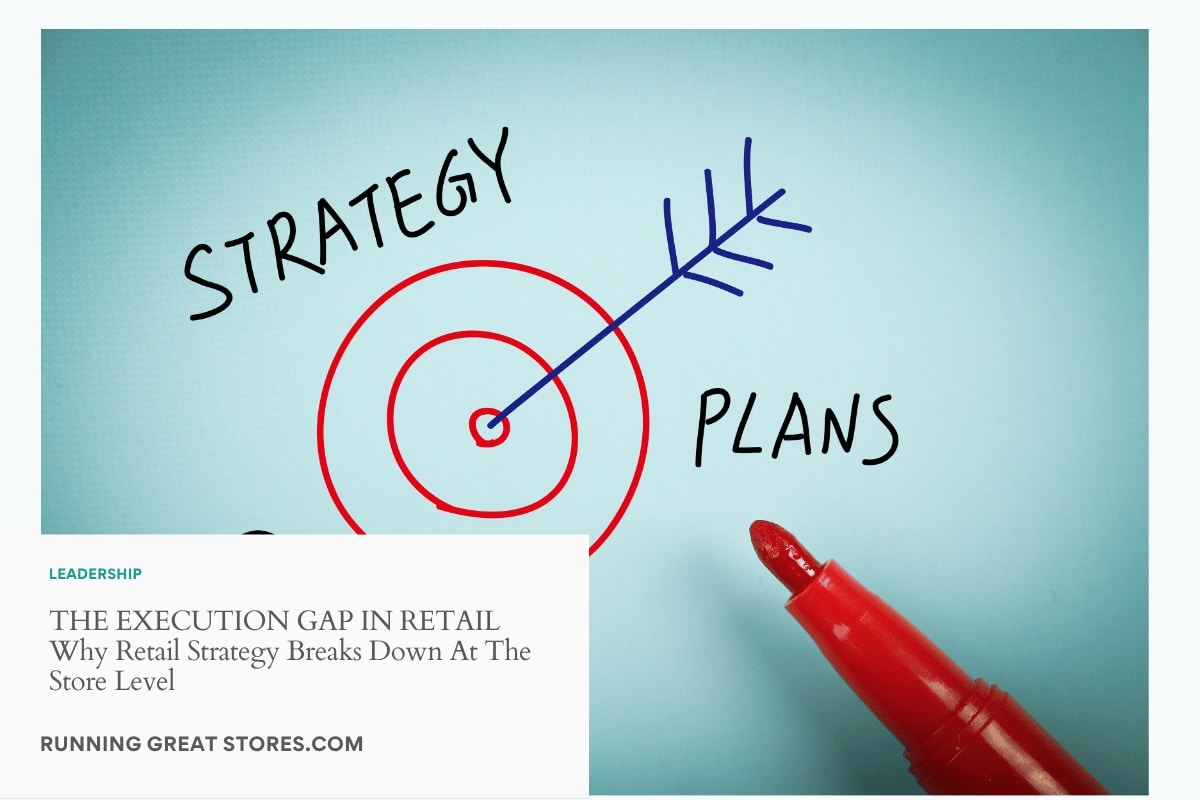
The execution gap in retail is one of the biggest reasons store strategy breaks down before it ever reaches the sales floor.
I started in retail as a way to work my way through college, fully expecting I would go on to become a lawyer.
But pretty quickly, I realized I had a real knack for retail (& no college fund with college loan debt piling up.)
I loved the pace.
I loved the people.
I loved the problem-solving.
I loved that you could make an immediate impact.
What started as a job became the place where I found my strengths, built my career, and began to understand something that has shaped the way I think about retail leadership ever since:
Retail performance is not just about strategy. It is about behavior.
The Real Question: Where Does Strategy Break Down?
In retail, we often assume that if the strategy is good, the execution should follow.
But it rarely works that way.
The corporate team may define the customer experience. The merchandising team may set the visual standards. The marketing team may launch the campaign. The field team may communicate the priorities.
But by the time all of that reaches the store, it has to be translated into something very practical:
- What do we do today?
- What matters most right now?
- What does good look like?
- What should the team repeat every single shift?
- What needs to be coached, reinforced, and followed up on?
That is where the execution gap lives.
The execution gap is the distance between what the company intends to happen and what actually happens on the sales floor.
It shows up when:
- A company launches a new clienteling strategy, but only some stores actually use it.
- Visual standards are clear, but execution varies dramatically by manager.
- Customer experience expectations are documented, but coaching is inconsistent.
- Training exists, but reinforcement does not.
- District priorities are communicated, but store teams do not know what matters most today.
The problem is not always the strategy. The problem is often the handoff from strategy to behavior.
Retail Is a Constant Reset Environment
One of the reasons execution is so challenging in retail is that stores operate in a constant reset environment.
Every day brings a new combination of people, priorities, pressures, and problems.
Stores are dealing with high turnover. New employees are joining constantly. Leaders are often promoted quickly because they were strong individual contributors or strong operators, not necessarily because they have been trained to lead, coach, reinforce behavior, or build consistency through others.
At the same time, store teams are navigating operational pressure every day.
- Customers need help.
- Shipment arrives.
- Someone calls off.
- The floor needs to be recovered.
- A promotion changes.
- A district priority shifts.
- A new initiative launches.
- The team is trying to drive sales, protect payroll, maintain standards, deliver service, and keep the store moving.
It is a lot.
And in that kind of environment, strategy does not execute itself.
It has to be translated into daily actions, repeated behaviors, and frontline accountability.
Leadership Is the Lever
The best retail leaders I have seen are not always the most charismatic. They are not always the most experienced. They are not necessarily the ones who give the most inspiring speeches.
What they do well is create clarity. They:
- Repeat expectations.
- Coach behavior.
- Simplify priorities.
- Follow up.
- Recognize what is working.
- Hold people accountable.
- Stay emotionally steady when the store gets chaotic.
Strong store leadership is less about charisma and more about repeatable behavior.
In retail, the best leaders are the ones whose teams know exactly what good looks like every day.
That does not happen by accident.
It happens because the leader has created a rhythm. The team knows the focus. The expectations are clear. Coaching happens in the moment. Standards are reinforced calmly and consistently.
That is how execution becomes part of how the store operates.
Why Trying to Fix Everything at Once Does Not Work
One of the biggest mistakes I see retailers make is trying to fix everything at the same time.
Consider the desire to improve:
- Sales.
- Service.
- Conversion.
- Clienteling.
- Visual standards.
- Accountability.
- Training.
- Communication.
All of those things may matter.
But when everything is urgent, everything becomes noise.
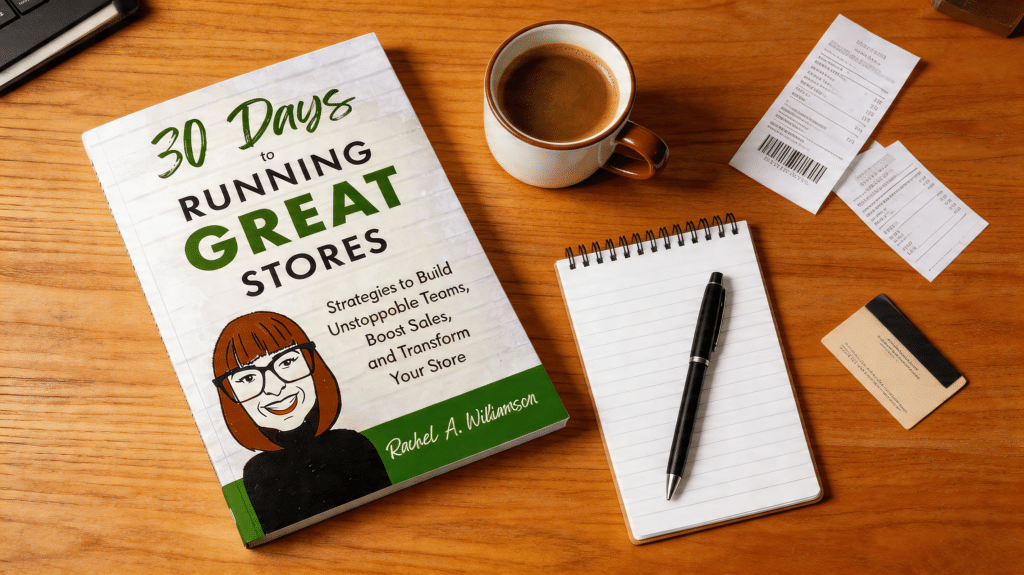
That is one of the reasons I wrote 30 Days to Running Great Stores. It is a practical response to the execution gap. The idea is simple:
Trying to fix everything at once creates noise. Building one leadership behavior at a time creates consistency.
Order your autographed and personalized copy of the book HERE!
If you want to improve execution, start smaller.
- Pick one behavior that matters.
- Define what good looks like.
- Practice it daily.
- Reinforce it in real time.
- Measure whether it is showing up.
- Repeat until it becomes part of how the store operates.
That might mean:
- Every shift starts with a clear priority.
- Every associate receives one piece of coaching per shift.
- Customers are acknowledged within a specific timeframe.
- The manager completes a floor walk with a specific focus.
- Team members can explain today’s sales goal and service focus.
The behavior itself matters.
But the repetition matters even more.
Consistency beats intensity.
A store does not improve because a manager gets fired up once. It improves because the right behaviors are repeated until they become normal.
Two Stores. Same Company. Very Different Results.
Imagine two stores in the same district.
Same brand.
Same product.
Same corporate strategy.
Same customer promise.
In Store A, the manager is reactive. Priorities change constantly. The team does not know what matters most. Coaching usually happens only when something goes wrong. New hires learn by watching whoever happens to be nearby. Results vary depending on who is working.
In Store B, the manager sets daily expectations. The team understands the focus. Coaching is frequent and specific. New employees are integrated quickly. Standards are reinforced calmly and consistently. Results are more stable.
What is actually different between these two stores?
Not the product. Not the brand. Not the strategy.
The difference is leadership behavior.
That is the part many retailers underestimate.
A strategy can be smart. A training program can be well-designed. A standard can be clearly documented. But if the frontline leader does not know how to turn it into daily behavior, the execution will be inconsistent.
What Future Leaders Need to Understand
For students entering leadership roles, and for anyone leading in retail today, there are a few lessons I believe are critical.
First, learn how work actually gets done. Do not just study the strategy. Study the handoff from strategy to execution.
Second, pay close attention to the frontline leader. Store managers, district managers, and middle managers often determine whether an initiative succeeds or fails.
Third, do not confuse communication with execution. Just because something was announced does not mean it is happening.
Fourth, in high-turnover environments, simplicity wins. The more turnover you have, the clearer and more repeatable your systems need to be.
And finally, consistency is a leadership skill. Being clear, steady, and repetitive may not feel glamorous, but it is often what drives performance.
The Real Work Begins After the Strategy Is Announced
I wish I had understood earlier in my career that leadership is not about having all the answers.
It is about creating the conditions where people can do the right things consistently.
In retail, that means making expectations clear, coaching behavior every day, and understanding that execution is built in small moments.
The further you move up in an organization, the easier it is to believe that strategy is the work.
But in retail, the real work begins after the strategy is announced.
- That is when the strategy has to become a conversation in a huddle.
- A coaching moment on the floor.
- A standard that gets reinforced.
- A priority that gets repeated.
- A behavior that becomes normal.
That is where leadership matters most.
And that is where great stores are built.
Bringing it Home
At Running Great Stores, we help retailers close the gap between strategy and store-level execution. Through retail playbooks, leadership development, operating rhythms, store assessments, and practical training, we help teams turn good ideas into consistent customer experiences across every store. To learn more, visit www.runninggreatstores.com, subscribe to the Running Great Stores Substack for weekly retail leadership insights, follow me on LinkedIn, and explore the Running Great Stores YouTube channel for practical training videos designed to help retailers lead stronger teams and run better stores.