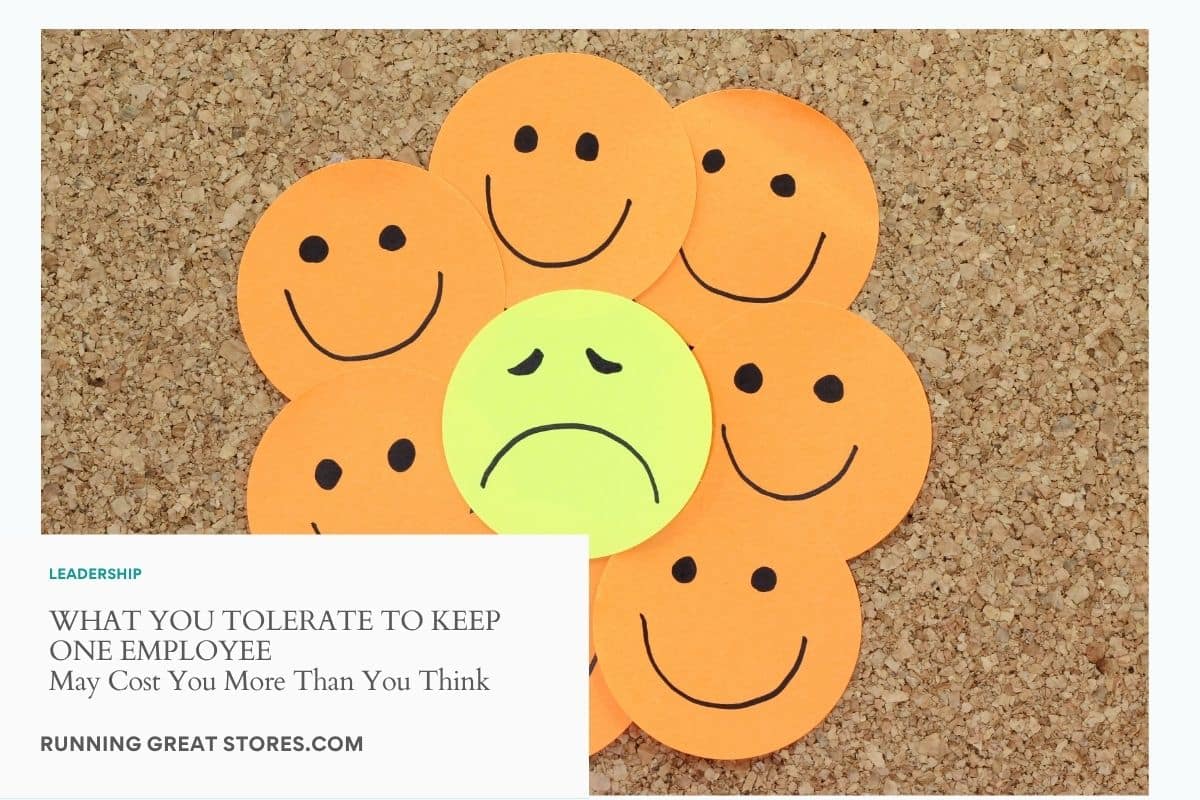
A business owner recently described an employee who regularly comes to work in a foul mood.
The employee stomps around the store, speaks sharply to others, and makes it very clear when she does not want to be there. Everyone notices. The energy shifts as soon as she walks in.
The owner notices too.
But she has not addressed it because she is afraid the employee will quit.
This is more common than many leaders want to admit.
Staffing is difficult. Recruiting takes time. Training someone new is expensive. When a business is already operating with a small team, the thought of losing another employee can feel overwhelming.
So the leader stays quiet.
She hopes the behavior will improve on its own. She tells herself the employee is going through something.
But avoiding the conversation does not make the problem disappear.
It simply transfers the consequences to everyone else.
The Rest of the Team Is Paying Attention
When one employee is permitted to be rude, dismissive, negative, or disruptive without being corrected, the team learns something about the leader.
They learn that the standards being discussed are not necessarily the standards being enforced, that certain employees are allowed to behave differently, and that keeping the schedule filled may matter more than creating a respectful workplace.
The strongest employees may not complain immediately. They may try to stay positive, work around the difficult person, and keep the day moving.
But over time, they begin to ask a reasonable question:
Why am I working so hard to contribute positively when someone else is allowed to make every shift more difficult?
Leaders are sometimes so focused on preventing one employee from quitting that they do not notice the damage being done to everyone who stays.
Employees Do Not Have to Be Happy Every Day
Addressing poor behavior does not mean leaders should expect employees to be cheerful every moment of every shift.
People have difficult mornings. They receive bad news. They experience stress, grief, family problems, health concerns, financial pressure, and exhaustion.
A compassionate leader makes room for people to be human. But there is a difference between having a hard day and creating a hard day for everyone else.
An employee can be quiet without being rude. They can say, “I am having a difficult morning, but I will be okay,” without stomping through the workplace or snapping at coworkers.
They can ask for a few minutes to collect themselves. What they cannot do is repeatedly make the rest of the team responsible for managing their emotions.
Professionalism does not require pretending. It requires understanding that personal frustration cannot routinely become everyone else’s workplace problem.
Avoidance Is Still a Leadership Decision
Leaders sometimes describe these situations as if they have not made a decision.
They say:
- “I have not said anything yet.”
- “I am waiting for the right time.”
- “I do not want to make it worse.”
- “I am afraid she will leave.”
But choosing not to address the behavior is still a decision. It is a decision to allow the behavior to continue.
It is a decision to ask the team to tolerate it. It is a decision to protect the difficult employee from discomfort while everyone else experiences the consequences.
The leader may believe silence is keeping the peace. In reality, silence often creates resentment, inconsistency, and confusion.
Address the Behavior Without Attacking the Person
The conversation does not need to begin with an accusation.
Do not say:
- “You always have a bad attitude.”
- “You are bringing everyone down.”
- “You clearly do not want to be here.”
Those statements label the person, make assumptions, and are likely to create defensiveness.
Instead, address what you have personally observed.
A leader might say:
“I have noticed that when you come in frustrated, it sometimes shows up in the way you speak to others and move through the store. This morning, for example, you spoke sharply to two team members and walked away when one of them asked you a question.”
Then clarify the expectation:
“The expectation is that everyone contributes to a respectful and professional work environment, even when they are having a difficult day.”
Next, invite the employee into the conversation:
“Can you help me understand what is going on?”
This allows the leader to remain curious without ignoring the behavior.
The employee may share something the leader genuinely needs to know. There may be a workload concern, conflict, misunderstanding, personal challenge, or other issue that deserves attention.
Listening is important. But understanding the reason for the behavior does not mean removing the expectation.
A leader can be compassionate and still say:
“I am sorry you are dealing with that. I want to support you where I can. At the same time, speaking disrespectfully to the team cannot continue.”
Make the Next Step Clear
A coaching conversation should not end with, “Let’s try to do better.”
The employee needs to understand what should change.
The leader could say:
“What I need you to do next is speak respectfully to your coworkers, respond when someone asks you a work-related question, and let me know privately if you need a few minutes to reset.”
Then explain how the leader will follow up:
“I will check in with you later today, and we will talk again at the end of the week about how things are going.”
This gives the employee a clear path forward.
It also communicates that the conversation matters and will not be forgotten as soon as the shift becomes busy.
What If the Employee Quits?
This is the fear underneath many avoided conversations.
- What if the employee becomes angry?
- What if she threatens to leave?
- What if the business is left even more short-staffed?
Those are real concerns.
But leaders also need to consider the other possibility:
- What if she stays and nothing changes?
- What if the team continues walking on eggshells?
- What if your strongest employee decides she has had enough?
- What if customers sense the tension?
- What if the leader becomes increasingly frustrated but feels even less capable of addressing the behavior later?
Keeping an employee is not always the same as retaining talent.
Sometimes a leader is merely retaining a problem because confronting it feels harder than accommodating it.
Leadership Requires the Conversation
Good leaders do not correct every sigh, quiet moment, or imperfect response.
They look for patterns. They pay attention to the effect behavior has on the customer, the team, and the workplace.
And when a pattern begins to damage the environment, they address it.
- That is not being unkind.
- It is not micromanaging.
- It is not failing to show empathy.
- It is protecting the standards of the business and the people who come to work ready to contribute.
You may be afraid that holding one employee accountable will cause that employee to leave.
But when poor behavior is repeatedly tolerated, someone else may already be considering it.
A Simple Place to Start
Think about a behavior you have been avoiding because you are afraid of how the employee might respond.
Ask yourself:
- What have I personally observed?
- What effect is it having on the team or customer experience?
- What is the reasonable workplace expectation?
- What specific behavior needs to change?
- When will I follow up?
Then have the conversation.
Your team does not expect you to prevent every difficult moment.
They do expect you to protect the kind of workplace you say you want to create.
Are inconsistent standards, difficult conversations, or employee accountability creating challenges in your stores?
The free Running Great Stores Scorecard can help you identify where leadership and execution may be breaking down across your organization.
And for practical leadership tools your store managers can begin using immediately, order a personalized, autographed copy of 30 Days to Running Great Stores at RunningGreatStores.com.
In Your Corner,